Amy Goodman Arrested at Republican National Convention
Democracy Now's Amy Goodman, Sharif Abdel Kouddous and Nicole Salazar were arrested by the Minneapolis Police Department. Charged with conspiracy to riot. Footage from Rick Rowley and Brandon Jourdan.
Watch in High Quality
Police fire teargas at protestors as they run away
Amy Goodman Free From Jail
"Democracy Now" host Amy Goodman was arrested Monday during the demonstration outside the Republican National Convention. She was freed Monday night. Here's her story:
from Democracy Now!
ST. PAUL--Democracy Now! host Amy Goodman and producers Sharif Abdel Kouddous and Nicole Salazar have all been released from police custody in St. Paul following their illegal arrest by Minneapolis Police on Monday afternoon.
All three were violently manhandled by law enforcement officers. Abdel Kouddous was slammed against a wall and the ground, leaving his arms scraped and bloodied. He sustained other injuries to his chest and back. Salazar’s violent arrest by baton-wielding officers, during which she was slammed to the ground while yelling, “I’m Press! Press!,” resulted in her nose bleeding, as well as causing facial pain. Goodman’s arm was violently yanked by police as she was arrested.
On Tuesday, Democracy Now! will broadcast video of these arrests, as well as the broader police action. These will also be available on: www.democracynow.org
Goodman was arrested while questioning police about the unlawful detention of Kouddous and Salazar who were arrested while they carried out their journalistic duties in covering street demonstrations at the Republican National Convention. Goodman’s crime appears to have been defending her colleagues and the freedom of the press.
Ramsey County Sheriff Bob Fletcher told Democracy Now! that Kouddous and Salazar were arrested on suspicion of rioting, a felony. While the three have been released, they all still face charges stemming from their unlawful arrest. Kouddous and Salazar face pending charges of suspicion of felony riot, while Goodman has been officially charged with obstruction of a legal process and interference with a “peace officer.”
Democracy Now! forcefully rejects all of these charges as false and an attempt at intimidation of these journalists. We demand that the charges be immediately and completely dropped.
Democracy Now! stands by Goodman, Kouddous and Salazar and condemns this action by Twin Cities’ law enforcement as a clear violation of the freedom of the press and the First Amendment rights of these journalists.
During the demonstration in which the Democracy Now! team was arrested, law enforcement officers used pepper spray, rubber bullets, concussion grenades and excessive force against protesters and journalists. Several dozen demonstrators were also arrested during this action, including a photographer for the Associated Press.
Amy Goodman is one of the most well-known and well-respected journalists in the United States. She has received journalism’s top honors for her reporting and has a distinguished reputation of bravery and courage. The arrest of Goodman, Kouddous and Salazar and the subsequent criminal charges and threat of charges are a transparent attempt to intimidate journalists.
Democracy Now! is a nationally-syndicated public TV and radio program that airs on over 700 radio and TV stations across the US and the globe.
Also, see 'Police Trap Peaceful Protestors' in Denver here
Tuesday, 2 September 2008


Federal Government Involved In Raids On Protesters http://www.commondreams.org/view/2008/09/01-5
by Glenn Greenwald
As the police attacks on protesters in Minnesota continue -- see this video of the police swarming a bus transporting members of Earth Justice, seizing the bus and leaving the group members stranded on the side of the highway -- it appears increasingly clear that it is the Federal Government that is directing this intimidation campaign. Minnesota Public Radio reported yesterday that "the searches were led by the Ramsey County Sheriff's office. Deputies coordinated searches with the Minneapolis and St. Paul police departments and the Federal Bureau of Investigation. (more)

Georgia is the graveyard of America's unipolar world
If there were any doubt that the rules of the international game have changed for good, the events of the past few days should have dispelled it ... the outcome of the war triggered by Georgia's attack on South Ossetia on August 7 is non-negotiable - and nothing the titans of the US empire do or say is going to reverse it. After that, the British foreign secretary David Miliband's posturing yesterday in Kiev about building a "coalition against Russian aggression" merely looked foolish.
Monday, 1 September 2008

U.S. warship met by anti-NATO protests in Ukraine's Sevastopol
SEVASTOPOL, September 1 (RIA Novosti) - The crew of U.S. Coast Guard Cutter Dallas, which arrived on Monday morning at the Ukrainian port of Sevastopol where Russia has a naval base, has refused to go ashore amid anti-NATO protests, customs officers said.
The Dallas, which recently delivered humanitarian aid to Georgia's Black Sea port of Batumi, docked at the Crimean port on the invitation of Kiev.
The ship was met with thousands of protesters chanting "Yankees go home!" and waving banners with the slogan "NATO Stop!" The area around the ship has been cordoned off by police, with an anti-NATO picket nearby.
Ukrainian customs officers who went on board the ship and met with the commander said the U.S. servicemen are refusing to leave the vessel on foot, but that buses could be provided so they can be given a tour of the city.
Tensions between Russia and the West have been exacerbated by the build-up in the Black Sea of U.S. and NATO naval vessels delivering humanitarian aid to Georgia. In an apparent response, Russia sent a group of warships last week, including the Moskva missile cruiser, to Sukhumi, the capital of Abkhazia.
Russia's Black Sea Fleet uses the Sevastopol base under agreements signed in 1997. Ukrainian President Victor Yushchenko announced earlier this year that Ukraine would not extend the lease beyond 2017.
Yushchenko signed a decree earlier this month requiring prior notice of all movements by Russian naval vessels and aircraft from the Sevastopol base in the Crimea.
The decree is not has not yet come into force, but Russia views it as a provocation and is likely to resist any Ukrainian attempts to restrict the deployment of its navy.
From Kosovo to Georgia
David Miliband should remember the scorn heaped on those of us who protested against Blair's Chicago speech in 1999
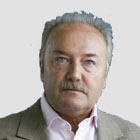
George Galloway, Guardian.co.uk, Monday 1 September 2008
Some might call it a lesson in the law of unintended consequences. For others, however, the bitter aftertaste of Tony Blair's saccharine-coated "doctrine of the international community" was all too obvious when he outlined it nearly a decade ago.
The reheated cold warriors who've fulminated over events in the Caucasus this month would do well to go back to that speech at the Chicago Economics Club in 1999.
Nato bombs were raining on Belgrade, eviscerating TV make-up women and destroying civilian infrastructure. Shamelessly, Blair posed as the stoic British prime minister who had voyaged across the Atlantic to remind America of its world historic role at the hour of Europe's need.
"On its 50th birthday Nato must prevail," he said, "Success is the only exit strategy I am prepared to consider."
He went on to locate the Kosovo war in the context of the then fashionable cliches of globalising capitalism and the changing roles of states and international alliances. The war's salience lay in recognising that the advance of the global free market depended on the preparedness of an undefined "international community" to, as he would put it two years later, "reorder this world" by force when necessary.
Thus, according to Blair in his address to Chicago neo-liberals, "The most pressing foreign policy problem we face is to identify the circumstances in which we should get actively involved in other people's conflicts".
That meant riding roughshod over the doctrine of the sovereignty of nation states dating from the peace of Westphalia – clearly his urge to modernise outdated notions had burst beyond such trifles as the welfare state and the Labour party.
Those of us who protested were castigated and calumniated against as the real dyed in the wool conservatives who had not understood that the world had moved on. In fact, our concern was that the Kosovo intervention and its justification were taking the world back. The sovereignty of nations was never an inviolable and faultless principle – and none of us on the left had said otherwise. But Blair's humanitarian interventionism, his 21st century civilising mission, was no advance on it.
It was a throwback to the Gladstonian liberal imperialism of the 1880s, which also was born with ballyhoo about Balkan atrocities, at that time Bulgarian. Two consequences flowed at the end of the 19th century.
First, peoples across the globe rapidly came to suffer murder and mayhem far worse and more extensive than any visited by one Balkan nationality upon another. The carnage in Africa, Asia, the Americas and Australasia still evades the North American and European imaginations because, quite simply, the victims were not white and the perpetrators were.
Second, as other states decided that they too had a duty to civilise, the scramble for Africa, China and elsewhere brought the European powers first into diplomatic conflict and skirmish, and then, when conquests in neither the east nor the west had filled their maw, into a cataclysmic clash on their own continent.
It's worth recalling the scorn heaped on those of us who raised these points nine years ago, warning of the vicious circle interventionist wars would unleash, and then turning to events today in the Black Sea's own Balkans.
Perhaps the mandarins of King Charles Street have a manual on how to hold a straight face and keep talking when all around are gasping incredulously. Maybe there's an homage to Kipling along those lines. Or maybe it's just the way our current foreign secretary is eerily adopting the tics and mannerisms of our former prime minister. Either way, David Miliband's performance over Georgia has been a spectacle to behold.
There was the bluster about the territorial integrity of small nations – this from a government that had only months previously proclaimed its support for ripping out Kosovo from what is left of Yugoslavia. The recognition by Washington and London of Kosovo's secession prompted a warning from Moscow, which, thanks to many years of Russian weakness and US triumphalism, was predictably ignored.
There are other nations besides Kosovo that might want to secede elsewhere and with greater claim, said the Kremlin, and if you recognise Kosovo against our wishes, don't be surprised if we end up recognising other secessionists against yours.
The frothing from Miliband and Condoleezza Rice when Russia did just that exposes the hypocrisy at the heart of western policy as outlined by Blair. When it comes down to it, for all the talk of universal moral objectives in international affairs, the right to pursue them turns out not to be universal, but to be vested in particular powers, and, it seems, some nations' rights are more inviolable than others.
They call it the international community, but it is not even the community of the permanent members of the UN Security Council, still less the UN General Assembly. It is, as with Kosovo, a community that is coterminous with the biggest military alliance on the planet, the North Atlantic Treaty Organisation, which has strayed very far indeed from the Atlantic.
For more than a decade, successive British and US governments could get away with this sleight of hand. Russia was enfeebled, robbed blind by foreign-domiciled billionaires. China was just a manufactured-in stamp piled high in the pound shop.
Not now. The unipolar future turns out to have been a moment in the past. And that makes the hubris that led from Kosovo through Iraq to today's missile shields and Cold War rhetoric all the more dangerous. One of the "collateral casualties" of the Kosovo war was the Chinese embassy in Belgrade. The result of a similar air strike in "rogue" capitals today doesn't bear thinking about. Nor do the consequences that would have flowed had Georgia been a member of Nato with its mutual military obligations.
The Russian action in Georgia has underscored the limits of US power, but Anglo-US arrogance is unabated. For the US – despite the dying days of the Bush administration – there is a logic. It is a global power, still the only true global power. However dangerous the game, it's not difficult to see why the US establishment, and not merely the Bush regime, plays it.
But why should Britain? Maybe it was the gap between western bombast and Russian facts on the ground, but there was something truly ridiculous about Miliband travelling to Ukraine to shake his fist at the east. He preached extending Nato membership to a country where two thirds of the people are not in favour of it and which is already ruptured by east/west tensions and internal conflicts that make Georgia look like Switzerland.
The Labour government in London again managed to outflank to the right Nicolas Sarkozy, Angela Merkel and even Silvio Berlusconi – but for what? To share this time not in foolish, short-lived triumph in the Middle East, but in Bush's humiliation.
The world is at that most dangerous of places: where one way of ordering states and systems is giving way to another. That usually doesn't happen without some major rupture and frequently with attendant violence. The worst place to be in such circumstances is as some ersatz power, an imperial hangover not of yesterday, but of the last century, busy threatening rising or renewing powers with the armies belonging to an ailing one.
Georgia's hapless president, the New York lawyer Mikheil Saakashvili, has just learnt what it means to plunge into dangerous waters on the ebb tide. It's a lesson that Britain's political elite would do well to heed.
Subscribe to:
Posts (Atom)